
If you feel bloated after almost every meal, you are not alone— and it may not be what you think.
In my clinical practice, I see this pattern again and again.
Someone sits across from me and says:
“I feel bloated after almost every meal.”
“I look fine in the morning and by evening, my stomach feels tight and swollen.”
“I’ve tried probiotics, digestive enzymes, cutting gluten… nothing really changes.”
Over time, it becomes exhausting.
Not just physically, but mentally.
You start questioning every meal.
You avoid foods randomly.
You feel frustrated because you’re trying and still not getting answers.
And here’s what I often explain to my patients:
The issue is frequently not just digestion.
It may be something happening on a deeper level.
The Symptom Pattern I noticed in my practice over the past years
Over the years, one pattern has stood out repeatedly. In my experience, the symptoms rarely appear in isolation.
Before undergoing advanced immune-based testing, many individuals report a remarkably consistent pattern of complaints.
In analyzed data sets, the most frequently reported symptoms included:
- Bloating reported by 18% of participants
- A persistent feeling of heaviness or fullness after meals 14%
- Unpleasant gas and abdominal pressure 10%
- Dry skin or recurring skin irritation 10%
- Low energy levels 9%
- Sleepiness after eating 8%
- Stomach pain 7%
- Heartburn 7%
What is striking is not just the frequency, but the overlap.
Most people did not report just one symptom.
They reported several.
Over time, these symptoms begin to feel “normal.” Something you simply live with.
Until you realize they aren’t.

The Consequence Most People Don’t See — and why it’s dangerous to just “leave it as is”
Here’s what concerns me most as a physician:
When symptoms persist, people begin eliminating foods without clear guidance.
First dairy.
Then gluten.
Then sugar.
Then entire food groups.
The result?
An increasingly restrictive diet, often without real improvement.
Over time, this can lead to nutritional imbalances, frustration, and a growing sense of confusion.
Patients tell me:
“I barely eat anything anymore and I still feel bloated.”
That’s usually the moment when we stop guessing.

The Common Misconception About “Gut Problems” 97% of people fall for
At this point, most people assume the issue must be their gut bacteria.
They are told to “repair the microbiome,” take stronger probiotics, add digestive enzymes, or remove gluten indefinitely. Entire industries are built around this idea.
But here is what often gets overlooked:
Not every digestive symptom is primarily a digestive disorder.
In many cases, the digestive tract is reacting to something, rather than failing to function.
This distinction matters.
When symptoms persist despite probiotics, enzyme supplements, or restrictive diets, it suggests that the underlying mechanism may not be insufficient digestion at all. It may be an immune response that is repeatedly triggered by specific foods.
And if that is the case, adding more supplements will not solve the problem because you are addressing the wrong system.
The Immune Response Most People Never Test
When the immune system identifies a substance as potentially problematic, it produces antibodies.
Most people are familiar with IgE antibodies — the type involved in immediate allergic reactions such as hives or swelling.
However, there is another category that receives far less attention: IgG antibodies.
IgG responses are typically delayed.
They do not cause dramatic, immediate reactions.
Instead, they may develop gradually after repeated exposure to certain foods.
When this happens, the immune system can remain in a state of ongoing activation. Over time, this repeated activation may contribute to low-grade, systemic inflammation.
And inflammation does not always look dramatic.
It can present as:
- Persistent bloating.
- A sensation of heaviness after meals.
- Fatigue.
- Brain fog.
- Skin irritation.
- Joint discomfort.
In clinical practice, this pattern is often overlooked because standard allergy panels focus on IgE, not IgG-mediated responses.
As a result, many patients are told their tests are “normal,” even though symptoms persist.

Why Unsystematic Restriction Rarely Works and makes your daily life harder and harder
One of the most common mistakes I see is random elimination.
Someone removes “eggs” from their diet, but continues to consume foods containing egg white protein without realizing it.
Others eliminate dairy, but tolerate certain milk proteins perfectly while reacting to others.
Food reactions are rarely black and white.
In fact, different components of the same food can trigger entirely different immune responses.
Without precise data, people are simply guessing.
And trial-and-error approach often leads to unnecessary restriction without symptom relief.
Why Random Elimination Often Fails
This is where many well-intentioned attempts go wrong.
People start eliminating entire food categories without knowing which specific component is actually triggering their immune response.
Take eggs as an example.
In aggregated testing data from over 9,000 individuals experiencing persistent digestive complaints, approximately 66% showed elevated IgG responses to egg white.
However, only around 30% reacted to egg yolk.
Without testing, most people would eliminate “eggs” altogether— or, conversely, continue consuming egg white protein in processed foods without realizing it may be contributing to their symptoms.
This illustrates a crucial point:
Food reactions are rarely simple.
And guessing rarely leads to clarity.
When patients restrict their diet blindly, they often remove foods unnecessarily— while continuing to consume the actual trigger.
That is not a sustainable solution.
It creates frustration. Nutritional imbalance. And ongoing inflammation.
Why Standard Allergy Testing Often Falls Short
At this point, many patients assume proper testing would have identified the issue.
“Why hasn’t this shown up in my previous tests?”
The answer is simple and often surprising.
Most conventional allergy panels focus on IgE antibodies.
These are responsible for immediate allergic reactions: swelling, hives, shortness of breath. Immediate IgE-mediated allergies are important to identify and manage. But they are only one part of the immune response spectrum.
They are important to test.
But they are not the whole picture.
Delayed immune responses—including IgG-related reactions—are not routinely included in standard allergy screenings. In many healthcare settings, they are not tested at all.
As a result, patients are often told:
“Your tests look normal.”
And yet, the symptoms continue.
This creates a frustrating gap between how someone feels and what their lab results show.
It is not that the symptoms are imagined.
It is that the right parameters were never measured.

The Modern Approach to Food-Related Immune Responses
In recent years, a more comprehensive approach has emerged.
Instead of focusing solely on immediate allergic reactions, advanced immune-based testing now allows for the analysis of IgG responses to a wide range of foods.
The process is straightforward.
A small blood sample is collected.
The sample is analyzed in a certified laboratory.
And within approximately one week, a detailed report identifies individual immune reactivity patterns across a broad panel of foods.
This approach does not rely on assumptions.
It relies on measurable immune markers.
Rather than eliminating foods blindly, patients receive personalized data that allows them to make informed decisions about their diet.
And that changes everything. Because clarity replaces assumption-based changes. And targeted adjustments replace restriction.
Making Advanced Immune Testing Accessible
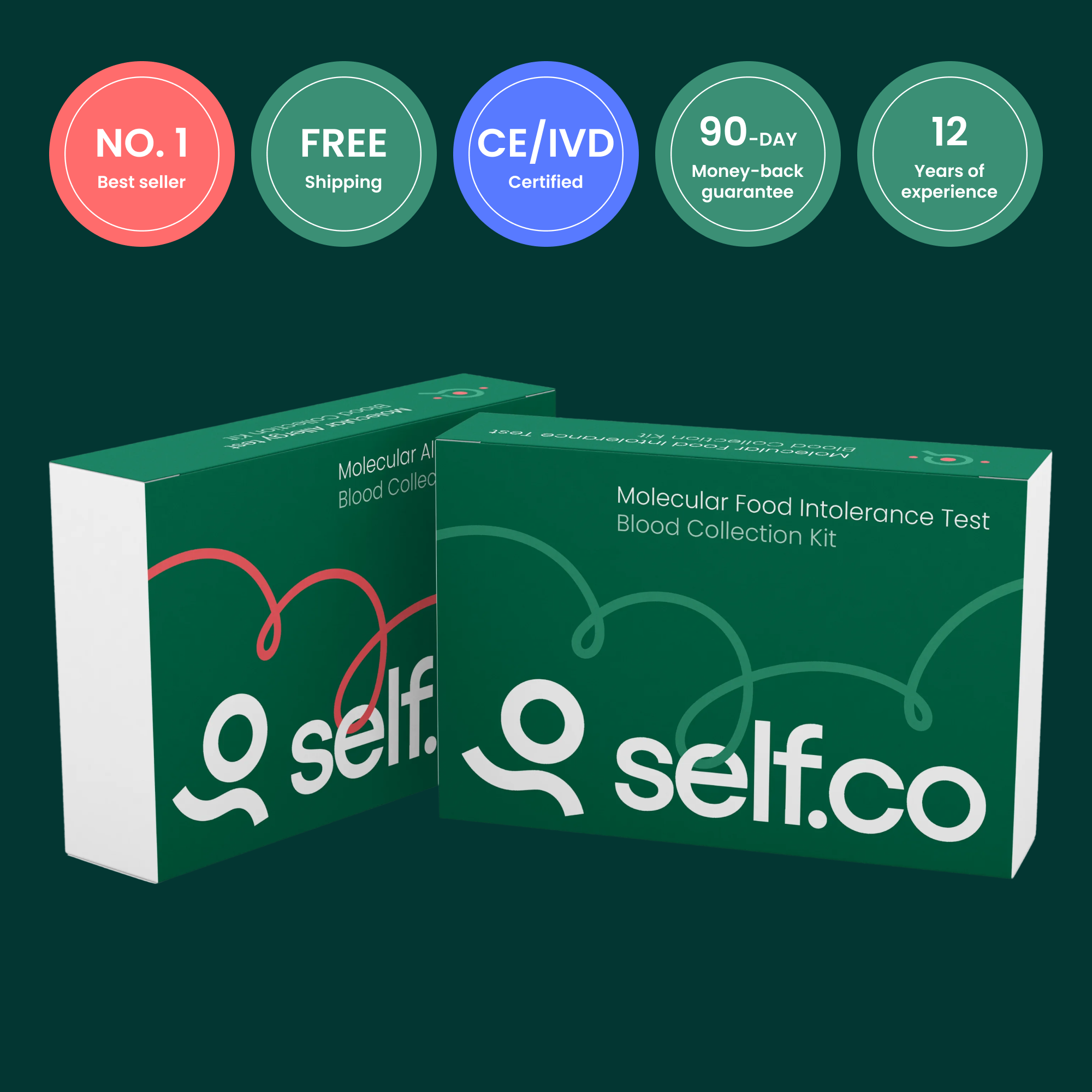
Self.co has made this advanced immune-based testing accessible from home.
Using a simple finger-prick blood collection method, individuals can test their IgG responses to over 220 foods— without scheduling appointments, waiting weeks for referrals, or navigating complex clinical processes.
The sample is analyzed in a certified clinical laboratory under standardized procedures. Within approximately one week, users receive a detailed digital report outlining their individual immune reactivity profile.
This level of insight was previously limited to specialized clinical settings.
Now, it can be done from home.
What makes this approach powerful is not restriction— it is precision.
Instead of removing entire food groups, individuals can identify specific triggers and make targeted adjustments based on measurable data.
For many, this is the first time their symptoms begin to make sense.

About Self.co
Self.co is a health technology company focused on making advanced immune-based diagnostics more accessible.
By combining certified laboratory analysis with user-friendly at-home testing, the company aims to bridge the gap between traditional clinical diagnostics and everyday health concerns.
Its testing methodology is based on validated laboratory procedures and designed to provide structured, data-driven insights, not generalized dietary advice.
The goal is simple: give individuals clarity about their immune responses so they can make informed, personalized decisions.
How the Process Works
Order online
Receive your test kit delivered to your door.
Fill a questionnaire
Provide information about your goals and symptoms.
Collect your sample
Just a small finger prick — easy, quick, and painless.
Get your results
Within 5–10 days, receive a clear report with personalized insights.
A More Accessible Alternative
Comprehensive immune-based testing in clinical settings can be costly and time-consuming.
Self’s at-home testing approach is designed to make advanced diagnostics significantly more accessible, at a cost that can be up to 90% lower than comparable in-clinic laboratory testing.
And currently, readers of this page receive an additional 50% discount.
This offer is available exclusively through this article and for a limited time.
For those who have struggled for months— or even years— without clear answers, this may be the first practical step toward understanding what is truly happening.
A Note on Scientific Integrity and Transparency
As a doctor, I believe that informed decisions require reliable data.
Self’s testing is conducted in certified laboratories using validated analytical technology. The results are not based on questionnaires or assumptions, but on measurable immune markers.
It is important to understand that no single test replaces medical consultation. However, structured immune profiling can provide valuable insight that helps individuals have more informed conversations with their healthcare providers.
Clarity is about understanding.
And understanding allows for targeted adjustments, rather than endless restriction.
Take the First Step Toward Clarity
If you have been dealing with persistent bloating, unexplained fatigue, or recurring digestive discomfort, and conventional approaches have not provided answers, a more precise assessment may be worth considering.
Through this page, you can access Self’s comprehensive immune-based testing kit with an exclusive 50% discount for a limited time.
- Testing from home.
- Certified laboratory analysis + free shipping & blood sample returns.
- Detailed results within approximately one week.
Sometimes, the most important step is not another elimination diet, but finally understanding what your immune system is reacting to.

About the Author
For over 15 years, Dr. Mitchell has worked with patients experiencing chronic digestive complaints, unexplained fatigue, and recurring inflammatory symptoms. Her approach focuses on identifying underlying triggers, not just managing surface-level discomfort.